A Resounding Call for an African Renaissance: A Landmark Work for Africa’s Future
AFRICA: RECLAIMING POWER AND DECOLONIZING MINDS
A Resounding Call for an African Renaissance: A Landmark Work for Africa’s Future
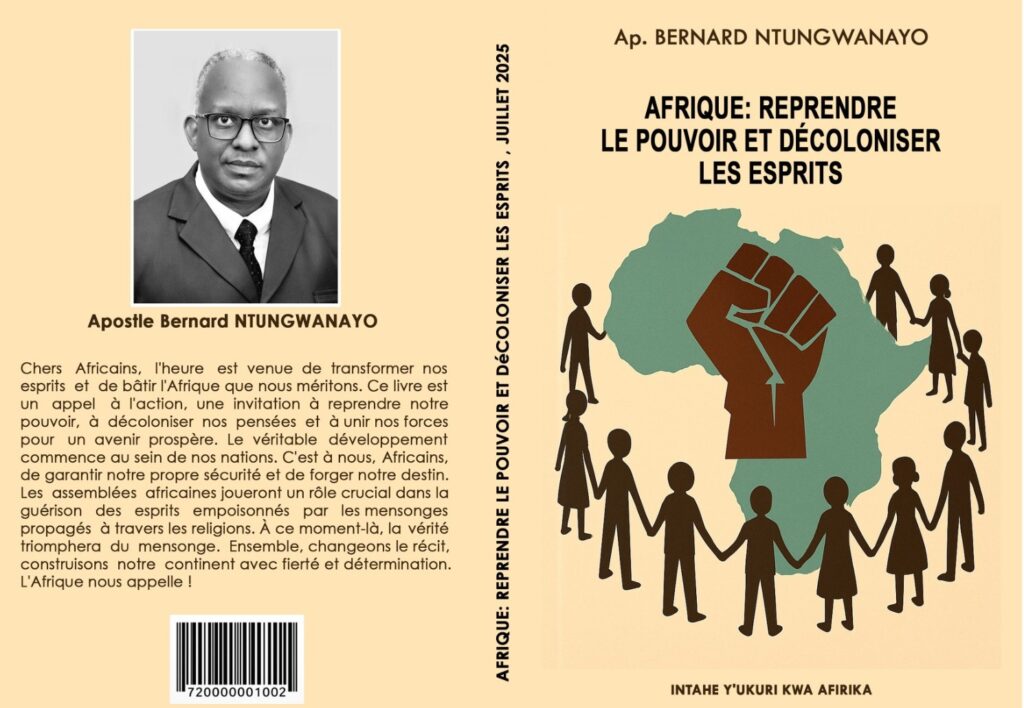
In a constantly evolving world, where historical narratives are often distorted and cultural identities threatened, Apostle Bernard Ntungwanayo, an eminent and respected figure from Burundi, offers us a masterful work that resonates like a powerful rallying cry for the African continent. His latest book, titled “AFRICA: RECLAIMING POWER AND DECOLONIZING MINDS,” is not just a book; it is a bold manifesto, a detailed roadmap, and a profound source of inspiration for a truly free, sovereign, and prosperous Africa.
This book arrives at a crucial moment in African history, calling for collective introspection and resolute action. It is addressed not only to leaders and intellectuals but also to every African citizen, encouraging them to take ownership of their destiny and build a better future for generations to come.
The Central Message: A Deep Decolonization of the Mind and Heart
With rare insight and incisive analysis, Apostle Ntungwanayo identifies the root of Africa’s persistent problems not in material poverty or lack of resources, but in a deep and insidious loss of sovereignty. This loss manifests in two interconnected forms: a tangible sovereignty, linked to the control of resources and institutions, and a spiritual and mental sovereignty, which affects self-perception and worldview. He highlights two forms of enslavement that have long hindered the continent’s progress and fulfillment:
1. The Loss of Tangible Sovereignty: The Exploitation of Wealth and Institutional Failure
The book eloquently deconstructs how Africa, a continent immensely rich in natural resources, has been systematically stripped of its wealth. Despite the abundance of precious minerals, fertile lands, and vast ecosystems, the continent paradoxically remains plagued by poverty, hunger, and conflict. The author explains in great detail how this wealth is exploited by external forces, often with the complicity of local elites, thereby fueling civil wars, corruption, and instability, rather than contributing to sustainable development and improving the living conditions of the people.
Ntungwanayo also addresses the critical failure of security and governance institutions. He points out that armies and police forces, which should be the guarantors of citizen security, have too often become instruments of oppression and repression, protecting private interests rather than the collective well-being. Similarly, state structures, meant to serve the people, are riddled with corruption and injustice, undermining citizens’ trust and hindering any attempt at progress.
2. The Colonization of Minds and Hearts: The Invisible Yoke of Mental Dependence
This is perhaps the most striking and original aspect of Ntungwanayo’s analysis. He argues convincingly that the real chain holding Africa back is invisible but deeply rooted: mental and spiritual colonization. This form of enslavement, more insidious than physical colonization, has led to a loss of self-esteem, the adoption of foreign values, and a psychological dependence on the West.
The author denounces how certain religious doctrines have been distorted and used as a tool of domination, encouraging submission, passivity, and the acceptance of injustice. He challenges the falsified historical narratives that have deliberately erased Africa’s past greatness, its primary role as the cradle of humanity, its powerful empires, its flourishing universities, and its ancestral wisdom. Ntungwanayo calls for an urgent reappropriation of African divinity, a reconnection with endogenous values and African philosophies, such as Ubuntu, which advocate for humanity, solidarity, and community.
The Solution: A Bold Roadmap for Liberation and Renaissance
Far from settling for a damning diagnosis, “AFRICA: RECLAIMING POWER AND DECOLONIZING MINDS” proposes concrete solutions, innovative strategies, and a detailed action plan for the continent’s liberation and renaissance. The author articulates a holistic and integrated vision of the African renaissance, covering several key areas:
- Economic Sovereignty: It is imperative to regain full control of Africa’s natural resources. This involves not only stopping the export of raw materials but also developing local processing industries, thereby creating added value on the continent and generating sustainable jobs for the African youth, who represent a vibrant and dynamic force.
- Security and Justice: Rebuilding armed forces and police that truly serve the people is essential. These institutions must be reformed to ensure the security of all citizens, fight corruption and impunity, and provide fair justice for all, far from partisan or individual interests.
- Pan-African Leadership: The book advocates for the emergence and support of new African leaders. These leaders must be upright, visionary, dedicated to the well-being of their nations, and carriers of a unifying Pan-African vision, capable of transcending borders and promoting regional and continental cooperation.
- Cultural and Educational Renaissance: It is crucial to value and promote African languages, traditions, arts, and philosophies. Education must be reformed to teach the true history of the continent, its past achievements, and its contributions to humanity, in order to build authentic pride and a strong identity among the younger generations.
- Mobilization of Youth and the Diaspora: The African youth are the engine of the future, and the diaspora represents an invaluable asset in terms of skills, resources, and influence. The book calls for mobilizing these two vital forces, connecting them, and providing them with the necessary opportunities to actively contribute to the continent’s construction and development.
A Specific Message for the Great Lakes Region: A Call for Unity and Reconciliation
As a child of the Great Lakes region, Apostle Ntungwanayo addresses the complex challenges and historical dynamics of this area with particular sensitivity. He deconstructs ethnic divisions, which he describes as colonial fabrications used to divide and rule. He emphatically highlights the historical and blood unity that binds the peoples of the region, calling for reconciliation, social cohesion, and the building of a common future based on mutual respect and solidarity.
The Author: Apostle Bernard Ntungwanayo, a Committed Visionary
Bernard Ntungwanayo, better known as Apostle Bernard Ntungwanayo, is a respected and influential Missionary Pastor based in Burundi. His reputation is built on his bold stances, his integrity, and his unwavering commitment to truth, justice, and social transformation. Beyond his pastoral role, he is a committed intellectual, a deep thinker, and a prolific writer.
Besides “AFRICA: RECLAIMING POWER AND DECOLONIZING MINDS,” he is also the author of other significant works that form a coherent body of thought. Among them, “The Hidden Face of Burundi’s History,” “Great Lakes: Identity Crisis,” and “The Deadly Virus of Lies” attest to his profound interest in the past, present, and future of his continent. These titles reveal a constant desire to deconstruct falsified narratives, heal identity wounds, and combat the disinformation that breeds violence.
His commitment is not limited to writing. As the president of the organization URN-HITAMWONEZA (Union for the Renaissance of the Nation), he is an active political voice who regularly addresses national and international bodies, such as the United Nations, on political crises and human rights violations in Burundi. His work is characterized by a unique combination of spirituality, socio-political analysis, and a passionate call to action.
Conclusion: The Time for Action Has Come for a Sovereign Africa
“AFRICA: RECLAIMING POWER AND DECOLONIZING MINDS” is much more than a literary work; it is a pressing invitation to collective introspection, to a sharp awakening, and, above all, to resolute action. As Apostle Ntungwanayo forcefully proclaims: “The time for lamentations and supplications is over. The time for action has come.” This is the decisive moment to build an Africa that is proud of its glorious past, confident in its present, and the absolute master of its future.
Get this book without delay, read it carefully, meditate on its profound messages, and share it widely with those around you. May it be the catalyst for transformative discussions, a powerful educational tool for African youth, and a source of inspiration for all who aspire to a new Africa. Africa, rise up! Reclaim your sovereignty. Decolonize your mind and your heart. Your future, and that of your children, is now in your hands.
Bien sûr, voici la traduction en anglais du texte que vous avez fourni.
AFRICA: RECLAIMING POWER AND DECOLONIZING MINDS
A Resounding Call for an African Renaissance: A Landmark Work for Africa’s Future
In a constantly evolving world, where historical narratives are often distorted and cultural identities threatened, Apostle Bernard Ntungwanayo, an eminent and respected figure from Burundi, offers us a masterful work that resonates like a powerful rallying cry for the African continent. His latest book, titled “AFRICA: RECLAIMING POWER AND DECOLONIZING MINDS,” is not just a book; it is a bold manifesto, a detailed roadmap, and a profound source of inspiration for a truly free, sovereign, and prosperous Africa.
This book arrives at a crucial moment in African history, calling for collective introspection and resolute action. It is addressed not only to leaders and intellectuals but also to every African citizen, encouraging them to take ownership of their destiny and build a better future for generations to come.
The Central Message: A Deep Decolonization of the Mind and Heart
With rare insight and incisive analysis, Apostle Ntungwanayo identifies the root of Africa’s persistent problems not in material poverty or lack of resources, but in a deep and insidious loss of sovereignty. This loss manifests in two interconnected forms: a tangible sovereignty, linked to the control of resources and institutions, and a spiritual and mental sovereignty, which affects self-perception and worldview. He highlights two forms of enslavement that have long hindered the continent’s progress and fulfillment:
1. The Loss of Tangible Sovereignty: The Exploitation of Wealth and Institutional Failure
The book eloquently deconstructs how Africa, a continent immensely rich in natural resources, has been systematically stripped of its wealth. Despite the abundance of precious minerals, fertile lands, and vast ecosystems, the continent paradoxically remains plagued by poverty, hunger, and conflict. The author explains in great detail how this wealth is exploited by external forces, often with the complicity of local elites, thereby fueling civil wars, corruption, and instability, rather than contributing to sustainable development and improving the living conditions of the people.
Ntungwanayo also addresses the critical failure of security and governance institutions. He points out that armies and police forces, which should be the guarantors of citizen security, have too often become instruments of oppression and repression, protecting private interests rather than the collective well-being. Similarly, state structures, meant to serve the people, are riddled with corruption and injustice, undermining citizens’ trust and hindering any attempt at progress.
2. The Colonization of Minds and Hearts: The Invisible Yoke of Mental Dependence
This is perhaps the most striking and original aspect of Ntungwanayo’s analysis. He argues convincingly that the real chain holding Africa back is invisible but deeply rooted: mental and spiritual colonization. This form of enslavement, more insidious than physical colonization, has led to a loss of self-esteem, the adoption of foreign values, and a psychological dependence on the West.
The author denounces how certain religious doctrines have been distorted and used as a tool of domination, encouraging submission, passivity, and the acceptance of injustice. He challenges the falsified historical narratives that have deliberately erased Africa’s past greatness, its primary role as the cradle of humanity, its powerful empires, its flourishing universities, and its ancestral wisdom. Ntungwanayo calls for an urgent reappropriation of African divinity, a reconnection with endogenous values and African philosophies, such as Ubuntu, which advocate for humanity, solidarity, and community.
The Solution: A Bold Roadmap for Liberation and Renaissance
Far from settling for a damning diagnosis, “AFRICA: RECLAIMING POWER AND DECOLONIZING MINDS” proposes concrete solutions, innovative strategies, and a detailed action plan for the continent’s liberation and renaissance. The author articulates a holistic and integrated vision of the African renaissance, covering several key areas:
- Economic Sovereignty: It is imperative to regain full control of Africa’s natural resources. This involves not only stopping the export of raw materials but also developing local processing industries, thereby creating added value on the continent and generating sustainable jobs for the African youth, who represent a vibrant and dynamic force.
- Security and Justice: Rebuilding armed forces and police that truly serve the people is essential. These institutions must be reformed to ensure the security of all citizens, fight corruption and impunity, and provide fair justice for all, far from partisan or individual interests.
- Pan-African Leadership: The book advocates for the emergence and support of new African leaders. These leaders must be upright, visionary, dedicated to the well-being of their nations, and carriers of a unifying Pan-African vision, capable of transcending borders and promoting regional and continental cooperation.
- Cultural and Educational Renaissance: It is crucial to value and promote African languages, traditions, arts, and philosophies. Education must be reformed to teach the true history of the continent, its past achievements, and its contributions to humanity, in order to build authentic pride and a strong identity among the younger generations.
- Mobilization of Youth and the Diaspora: The African youth are the engine of the future, and the diaspora represents an invaluable asset in terms of skills, resources, and influence. The book calls for mobilizing these two vital forces, connecting them, and providing them with the necessary opportunities to actively contribute to the continent’s construction and development.
A Specific Message for the Great Lakes Region: A Call for Unity and Reconciliation
As a child of the Great Lakes region, Apostle Ntungwanayo addresses the complex challenges and historical dynamics of this area with particular sensitivity. He deconstructs ethnic divisions, which he describes as colonial fabrications used to divide and rule. He emphatically highlights the historical and blood unity that binds the peoples of the region, calling for reconciliation, social cohesion, and the building of a common future based on mutual respect and solidarity.
The Author: Apostle Bernard Ntungwanayo, a Committed Visionary
Bernard Ntungwanayo, better known as Apostle Bernard Ntungwanayo, is a respected and influential Missionary Pastor based in Burundi. His reputation is built on his bold stances, his integrity, and his unwavering commitment to truth, justice, and social transformation. Beyond his pastoral role, he is a committed intellectual, a deep thinker, and a prolific writer.
Besides “AFRICA: RECLAIMING POWER AND DECOLONIZING MINDS,” he is also the author of other significant works that form a coherent body of thought. Among them, “The Hidden Face of Burundi’s History,” “Great Lakes: Identity Crisis,” and “The Deadly Virus of Lies” attest to his profound interest in the past, present, and future of his continent. These titles reveal a constant desire to deconstruct falsified narratives, heal identity wounds, and combat the disinformation that breeds violence.
His commitment is not limited to writing. As the president of the organization URN-HITAMWONEZA (Union for the Renaissance of the Nation), he is an active political voice who regularly addresses national and international bodies, such as the United Nations, on political crises and human rights violations in Burundi. His work is characterized by a unique combination of spirituality, socio-political analysis, and a passionate call to action.
Conclusion: The Time for Action Has Come for a Sovereign Africa
“AFRICA: RECLAIMING POWER AND DECOLONIZING MINDS” is much more than a literary work; it is a pressing invitation to collective introspection, to a sharp awakening, and, above all, to resolute action. As Apostle Ntungwanayo forcefully proclaims: “The time for lamentations and supplications is over. The time for action has come.” This is the decisive moment to build an Africa that is proud of its glorious past, confident in its present, and the absolute master of its future.
Get this book without delay, read it carefully, meditate on its profound messages, and share it widely with those around you. May it be the catalyst for transformative discussions, a powerful educational tool for African youth, and a source of inspiration for all who aspire to a new Africa. Africa, rise up! Reclaim your sovereignty. Decolonize your mind and your heart. Your future, and that of your children, is now in your hands.
Contact whatsApp: + 1 929 923 0462